There is a hill in Rome that is not a hill.
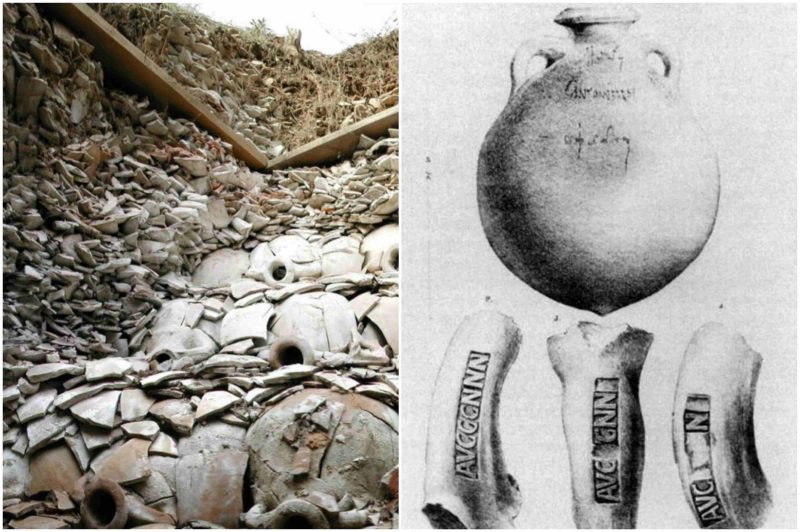
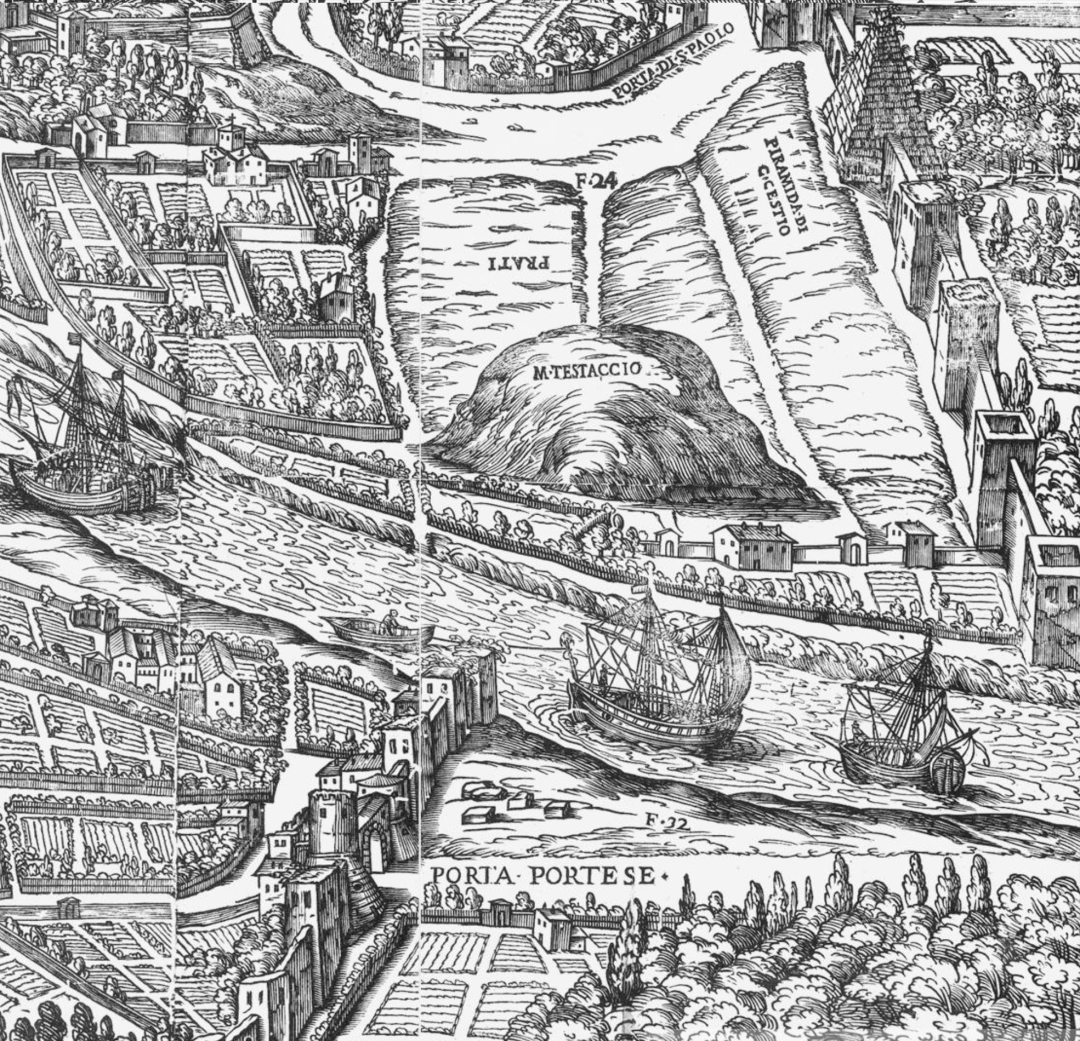
It sits behind the Aventine, near the old river port, and it rises about thirty five meters above the surrounding ground, and it is entirely artificial, and it is made of broken pottery. Archaeologists estimate that Monte Testaccio contains the remains of something in the region of fifty three million amphorae, which were the standard shipping containers of the ancient Mediterranean, and which arrived in Rome full of olive oil from the Spanish province of Baetica and were smashed and stacked here once emptied, because the porous clay held the oil residue and turned rancid and could not be reused.
What makes the hill remarkable is not its size but its paperwork. A great many of those broken handles carry stamps and painted inscriptions recording the weight of the vessel, the weight of the oil, the name of the estate that pressed it, the name of the merchant who shipped it, and in many cases the name of the official who checked the figures. A shard from that hill can tell you which farm in southern Spain grew the olives that filled it, in which year, and who was legally answerable if the quantity was wrong.
So the oldest surviving mountain of consumer packaging in the world is also the oldest surviving archive of brands, and the two things are the same object, which is the first thing I want to point out and which I think is not a coincidence at all.
The oil is gone. Everyone who drank it is gone. The estates are gone, and the empire that organized the shipping is gone. What is left is the container and the mark on it, piled thirty five meters into the Roman sky.
I. The word means burning
Our word for all of this descends from a Germanic root meaning a burning, surviving in Old English as brond and in Old Norse as brandr, and denoting a firebrand, a piece of wood taken out of the fire. It became a verb describing what you do to livestock with a hot iron so that everyone in the valley knows whose animal has wandered into their field.
I think it matters enormously that the original act was performed on flesh, by force, in order to settle a dispute about ownership. The first brand was not a promise made to a customer. It was a claim asserted against a neighbor, and it was inflicted rather than offered, and its entire content was the single proposition that this thing belongs to me.
Every subsequent development in the history of branding is the story of that mark slowly changing what it is for, migrating across two thousand years from a claim asserted against a rival into an assurance offered to a stranger, and therefore from a statement about the past into a statement about the future. The Roman stamp on the amphora handle sat exactly halfway through that journey, because it told you where the oil came from, which was a fact you could verify, and it also told you what kind of oil to expect, which was a prediction you could not.
II. The mark and the promise
Every brand that has ever existed does two entirely different jobs, and almost all the confusion in this industry comes from treating them as one job.
The first job is the mark, which is a statement about origin. It says this object came from that source, and it points backward at a fact in the world, and it can be checked. A hallmark on silver, a signature on a canvas, a serial number, a certificate of authenticity, the little tag sewn into a garment. The mark is fundamentally a piece of evidence, and its value depends entirely on how hard it is to forge.
The second job is the promise, which is a statement about the future. It says that when you use this thing, the following will happen, and you will feel a particular way, and the experience will resemble the last time. The promise points forward and cannot be verified in advance, which is precisely why it has to be believed rather than checked, and belief is expensive to manufacture.
The whole history of branding is the migration of economic value from the first job to the second. And the reason this history matters right now is that AI does something very specific and very asymmetric to each of them, which we will get to, but which will not make sense unless the distinction is already sitting in your hand.
III. How the mark became law
For most of recorded history the mark was enforced by violence, and this is worth remembering whenever someone describes branding as a soft discipline.
English hallmarking began in earnest in 1300 under a statute of Edward the First requiring that silver be assayed and struck with a leopard's head before it could be sold, and by the fifteenth century the marking was administered at Goldsmiths' Hall in London, which is where the word hallmark comes from, since it meant quite literally the mark of the hall. A goldsmith who struck a false mark was not sued. He was prosecuted, and the penalties were severe, because the mark was understood as a species of currency and falsifying it was understood as a species of forgery.
The medieval guilds operated on the same logic across every trade, requiring makers to strike their personal marks on their output so that defective work could be traced to a specific pair of hands and punished, which means that the guild mark was a device for allocating blame long before it was a device for attracting custom. Reputation was a byproduct of liability. It took several centuries for anyone to notice that the byproduct was worth more than the mechanism.
Modern trademark law arrives in 1875, when the United Kingdom passed the Trade Marks Registration Act, and the first mark registered under it, in 1876, was the red triangle of Bass Brewery, which is often described as the first registered trademark in the world. What I find impossible to forget about the Bass triangle is where it turns up. Stand in front of Manet's A Bar at the Folies-Bergere, painted in 1882 and hanging now in the Courtauld, and look at the bottles ranked along the marble counter on the right, and you will find two of them wearing red triangles, painted with enough care that they are unmistakable.
One of the founding masterpieces of modern painting contains a legally registered trademark, rendered faithfully, six years after registration. The brand had become part of the visual furniture of ordinary life almost immediately, which tells you the speed at which these things embed themselves once the law makes them stable.
IV. The disappearance of the grocer
Law made the mark stable, but law alone would never have turned it into an industry. That took packaging, and the mechanism is more interesting than it first appears.
Through most of the nineteenth century, ordinary goods were sold loose. Flour and oats and soap and tea came out of barrels and sacks behind a counter, measured by a grocer who knew your family, and the guarantee of quality was that grocer's face and the fact that you would see it again next week. Quality assurance was a social relationship, conducted at human scale, enforced by proximity.
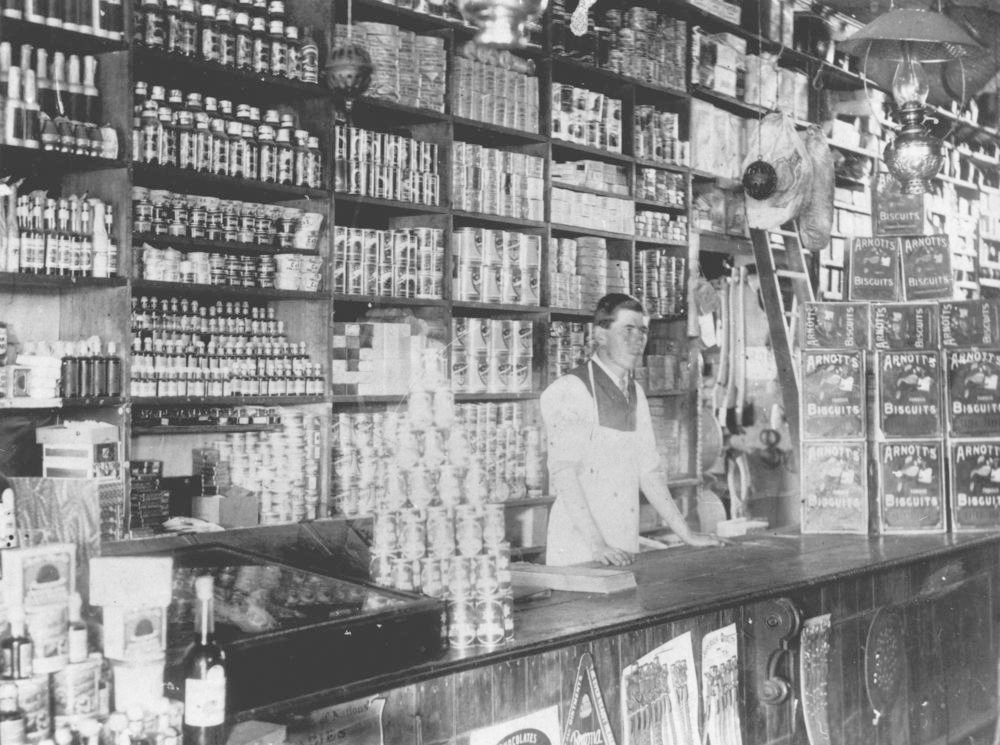
Industrial production broke that arrangement, because a factory in one city now supplied a hundred thousand households in fifty others, and the man behind the counter had no idea what was in the sack either. What filled the vacuum was the sealed package with a name on it. Quaker Oats registered in 1877. Ivory Soap arrived in 1879 with a claim of being ninety nine and forty four hundredths percent pure, which is a strange and specific and therefore extremely persuasive number. Coca Cola in 1886.
So the modern brand is a prosthesis for a lost relationship. It exists because the grocer disappeared and something had to stand in the place where his face used to be, and it works to the exact extent that it can produce the feeling of being known by someone who is accountable to you.
That is not a cynical description. It is a functional one, and it explains why brands have always been strongest in categories where you cannot inspect the goods before buying and cannot easily assess them after.
V. What actually makes a brand stick
Here the essay has to stop telling stories and look at evidence, because there is a large empirical literature on this and most of what agencies say about brands contradicts it.
The most useful body of work comes from the Ehrenberg-Bass Institute, and Byron Sharp's How Brands Grow, published in 2010, is the readable summary. The central finding is uncomfortable for anyone who sells brand strategy. Brands do not grow primarily by differentiating themselves in the minds of a loyal core, because loyalty is largely a function of size rather than a cause of it, and heavy buyers of any brand are far rarer than the industry assumes. Brands grow by being mentally available, meaning that they come to mind readily in a buying situation, and physically available, meaning that they are actually there when the hand reaches out.
Which relocates the whole discipline from persuasion to memory. What makes a brand stick is not that people have been convinced of an argument about it. It is that the brand has built distinctive assets, being colors and shapes and sounds and typefaces and characters, which are consistent enough over enough years that recognition happens below the level of conscious thought.
That account explains how a brand gets retrieved, and it leaves open a separate question, which is why anybody believes the brand once it has been retrieved. The best answer I know comes from Philip Nelson's work in the 1970s on advertising as information, and the two arguments are doing different jobs rather than competing. His observation was that for goods whose quality you cannot judge before purchase, the content of an advertisement is nearly worthless as evidence, since anyone can claim anything. What carries information is the expenditure itself. A company that spends enormously and publicly on a campaign is demonstrating that it expects to be around long enough to recoup the money, and a fly by night operation cannot afford to make that demonstration. The advertisement works as a signal not because of what it says but because of what it cost to say it.
Brand building, on this account, is a form of conspicuous burning. You set money on fire where everyone can see you do it, and the fire is the message, which means the word we started with has been accurate for a thousand years in a way nobody intended. The mark was burned into the animal. The promise is made by burning money in public. Both are expensive on purpose, because a signal that costs nothing proves nothing.
Hold that thought, because it is the one that AI attacks.
VI. The most valuable brands, and why the number is a story
People ask which brands are worth the most, and the honest answer is that the question has three respected answers that disagree with one another by more than a factor of two, and the disagreement is more instructive than any of the figures.
Brand valuation as a formal practice is usually dated to 1988, which was the year Rank Hovis McDougall put acquired brands on its balance sheet as assets, and the year Philip Morris bought Kraft for something close to twelve and a half billion dollars, which was roughly four times the book value of Kraft's tangible assets. Somebody had paid nine billion dollars for nothing you could touch, and accountants were forced to develop a vocabulary for what had been purchased.
Today three organizations publish annual rankings. Interbrand values brands by isolating the earnings attributable to the brand and discounting them by the strength of the brand's role in driving choice. Kantar's BrandZ leans heavily on large scale consumer research into how much of the purchase decision the brand is responsible for. Brand Finance uses a royalty relief method, asking what a company would have to pay to license its own name if it did not own it.
Apple has sat at or near the top of all three for well over a decade, followed in some order by Microsoft, Google, Amazon, and in the Kantar rankings usually a Chinese platform or two that the Western lists rank lower. But Interbrand's valuation of Apple has run in the hundreds of billions while Kantar's has run past a trillion, on the same company, in the same year, using the same public financials.
That gap is not a scandal and it is not incompetence. It is the honest consequence of trying to put a number on a promise, and the fact that three careful methodologies produce answers that far apart is the most accurate available statement about what a brand is. A brand valuation is not a measurement. It is an argument about the future, expressed in dollars because that is the format the audience accepts, which makes it the most expensive piece of brand storytelling any of these companies commissions.
VII. What AI actually changes
Now we can be precise, and I want to argue that most of the discussion here is aimed at the wrong half of the definition, because the mark and the promise are affected in opposite directions and almost nobody is separating them.
The surface stops signalling
AI drives the cost of producing brand assets toward zero, and by assets I mean the visible surface, being the logo and the palette and the photography and the copy and the site and the deck. A company of four people can now generate a visual identity that looks like it cost two hundred thousand dollars, in an afternoon, for the price of a subscription.
If Nelson was right, and I think he was, this is not a minor efficiency but the partial destruction of a signal. The reason polished identity work has always communicated seriousness is that it was expensive, and therefore only affordable to organizations that expected to survive long enough to recoup it, so that looking expensive was informative precisely because looking expensive was costly. When everyone can look expensive, looking expensive stops carrying information, in the same way that a currency stops carrying value at the moment anyone can print it.
So the signals of seriousness will migrate to whatever remains costly, which will be duration, and institutional behavior, and physical presence, and demonstrated consequence, and the willingness to be publicly accountable for something that might go wrong.
Everything converges, which is the opportunity
Here is the consequence that I think the industry has not yet absorbed, and it is the reason I am optimistic rather than defensive.
When a tool is trained on the aggregate of what has already been made, and when it becomes the cheapest way to make anything, the output converges on a center of mass, and the center of mass is by definition the place where everything looks like everything else. You can already see this happening in public, and the tells are becoming legible to ordinary people rather than only to professionals. There is a particular landing page, with its centered hero and its soft gradient and its glassy card, that a great many companies now share without having chosen it. There is a particular quality of light in generated imagery that has no source in any room. There is a particular rhythm in generated prose, and the tell has become well enough known that writers have begun stripping em dashes out of their work simply to avoid the association, which is a remarkable thing to observe: people are now editing their own habits to prove they are human.
That convergence is not a small aesthetic complaint. It is an economic event, and the reason sits in the empirical literature above. If the empirical literature is right that brands grow through distinctiveness and mental availability, meaning through being recognizable at a glance and retrievable from memory without effort, then a technology that makes everything resemble everything else is attacking the exact mechanism by which brands work. The cheapest way to produce brand assets has become one of the most reliable ways to produce a brand that nobody can pick out of a lineup.
Which inverts the fear. The standard prediction is that cheap production destroys the market for people who are good at this. My prediction is the opposite, and I would put it plainly: when everyone can produce something competent, competence stops being worth paying for, and the only thing left worth paying for is the thing that could not have come out of the average. Distinctiveness has just become scarce, and scarcity is where money goes.
And the same tools that caused the problem happen to be extraordinary in the hands of someone who already knows what they are doing, because the thing they actually compress is iteration. Work that used to take a week of exploration to even find the edges of can now be probed in an afternoon, which means a designer with real judgment can go considerably further out from the obvious before committing, and can afford to test the strange idea that would previously have been too expensive to try. The tool does not supply the judgment. It removes the tax on using it.
I think we are more likely to see creativity flourish than collapse, and I think the visible wave of sameness right now is a transitional phase rather than a destination, because people will tire of looking like everyone else long before they tire of wanting to be looked at.
A brand persona is excavated, not generated
There is a specific failure I want to name, because I expect a great deal of money to be wasted on it over the next few years.
A brand is not only a mark and a promise, since somewhere in the middle it also becomes something close to a character, with a temperament and a set of things it would never say and a way of behaving under pressure. That character is what people actually form attachments to, and it is the reason brand work overlaps so heavily with writing.
You cannot generate that character, and the reason is the same reason a badly written film character falls flat. Invented personality assembled from the average of all personalities produces a composite, and composites are recognizable instantly as hollow, because what makes a character convincing is never breadth but specificity, being the particular detail that nobody would have thought to invent. A generated brand voice will be fluent, agreeable, well structured, and completely unable to survive contact with a real audience, for exactly the same reason that a movie character written from tropes cannot survive a close up.
The character has to be excavated instead, and I mean that word literally, because the material is already there before anyone starts. It sits in the founder's actual decisions, and in what they have refused to do and why, and in the story of what went wrong in year two, and in the specific thing that irritates them about their own industry. The job is not invention. It is extraction, followed by construction, and the difference between the two is the difference between a brand that holds and a brand that evaporates on contact.
And this is where AI turns out to be genuinely useful in brand work, in a way that has nothing to do with generating deliverables. The hardest part of excavation has always been that founders and stakeholders often cannot articulate what they see, since the vision is real and vivid and entirely non verbal, and the usual vocabulary of briefs, being words like premium and modern and bold, means something different inside every head that holds it. What these tools provide is a fast way to put something in front of a person and watch them react, and the reaction is the data. Generate six directions in an hour, and the founder will look at the fourth one and say that it is wrong in a way that finally tells you what right would be. That is not a shortcut around the discovery process. It is an instrument for conducting it, and it works because recognition is far easier for human beings than description.
The tool is not producing the brand. It is producing a shared vocabulary between people who could not previously get onto the same page.
The machine becomes an audience
For as long as there have been brands in the modern sense, which is to say since the sealed package replaced the grocer, they have been optimized for retrieval from human memory, which is why they lean on color and shape and sound and repetition, since those are the handles a human mind can grab.
If a meaningful share of purchasing decisions begins to be intermediated by machines, then part of the brand's job shifts from being memorable to being legible, and from occupying availability in a person to occupying whatever the machine equivalent turns out to be, which will have something to do with how consistently and coherently a company is described across the corpus a model was trained on and the sources it retrieves from. That is a genuinely new problem, nobody credible knows how it will work yet, and I would treat anyone selling a methodology for it today with considerable suspicion.
Verification becomes scarce, and therefore valuable
The last change runs against the first two, and it is the one I find most interesting, because it brings the essay back to where it started.
For roughly two centuries the mark has been a solved and boring problem. When you buy a box of running shoes you do not spend any energy wondering whether the shoes inside are really made by the company on the box, because authenticity was cheap to establish and cheap to check, and so nobody built brand strategy around it. All the money and all the ambition went into the promise instead, which is why brand work today means positioning and story and tone of voice, and why proving that you are who you say you are was left to the lawyers.
What almost every discussion of AI misses is that it did not only lower the cost of creation. It lowered the cost of forgery by exactly the same amount. A convincing counterfeit of an entire company is now close to free to produce, complete with product photography of items that were never manufactured, reviews written in fluent and specific English by nobody, a cloned site carrying your palette and your typefaces, testimonials from customers who do not exist, and video of a founder who was never filmed. Your costs fell, and the costs of the person impersonating you fell in precisely the same proportion.
When forgery becomes cheap, proof becomes scarce, and scarcity is where value goes.
So the ancient and unglamorous half of the definition stops being plumbing and becomes strategy. In practice that means provenance recorded at the point of capture, and serialized identifiers in physical goods, and named human beings with track records that can be checked rather than a stock photograph of a team, and independent certification, and physical premises, and events that happen in rooms, and supply chains a customer can actually trace. What all of those share is that they cost something real to produce and cannot be conjured in an afternoon, which is the entire property that makes a signal worth anything.
We may be heading back toward Monte Testaccio. What made a household in Rome willing to buy oil from a farm in Spain that nobody in the family would ever see was not the persuasive material on the jar. It was the fact that an accountable official had independently checked the quantity and put his name beside the figure. Verification by a third party with something to lose was the load bearing element of the whole arrangement, and we have spent two hundred years being able to take it for granted, and we are now entering a period in which it will have to be designed on purpose.
VIII. The strongest case against all of this
The serious objection is that brands are a tax on ignorance, and that the entire apparatus is rent extraction dressed as meaning.
On this account, a brand premium is what you pay for not being able to evaluate a product properly, and the branded aspirin and the generic aspirin are chemically identical, and the difference in price is purely the cost of your own uncertainty. It follows that any technology which reduces uncertainty should dissolve brands, and AI is the most powerful uncertainty reducing technology ever built, since an agent that can read every specification and every review and every teardown does not need a comforting logo to make a decision. On this view brands are not becoming more important. They are approaching obsolescence, and the industry insisting otherwise is precisely the industry that would go out of business if it were true.
I think this argument is much stronger than most people in my profession are willing to admit, and I think it is correct about a specific range of categories, being the ones where the relevant qualities really are fully specifiable, such as commodity components and storage capacity and interest rates.
Where I think it fails is that it assumes evaluation is the bottleneck. For most of what people actually buy, the qualities that matter are not specifiable in advance, because they concern how a thing will feel to live with, and whether the company will still exist to honor the warranty, and whether the people behind it will behave decently when something goes wrong. No amount of information solves a problem of trust extended into the future, because the future has not happened yet and no dataset contains it. That gap is where brands have always lived, and it is not an information gap that better search closes. It is a structural feature of committing to something before you know how it turns out.
IX. The hill
Which brings us back to the fifty three million broken jars behind the Aventine.
Everything that mattered to the people who made them is gone. The oil is gone, and everyone who ate it is gone, and the estates are gone, and the shipping lanes reorganized themselves and then the province declined and then the empire that ran the whole arrangement ended. What remains is the packaging, stacked thirty five meters into the sky, with the names still perfectly legible on the handles.
I want to propose the thing this essay has been circling from the first paragraph, because I think it is the real answer to the question in the title and I do not think it is usually said out loud.
Ernest Becker argued in 1973 that almost everything human beings build which outlasts them is an argument with their own mortality, and that culture itself functions as an immortality project, being the mechanism by which a creature that knows it will die arranges to leave something in the world that will not. Whatever you make of the psychology, the pattern is difficult to unsee once you are looking for it, and I have never sat in a founder's office and found it absent.
Because the economics do not explain the intensity. Founders care about their brands far past the point where caring produces any return, and they argue about a typeface at eleven at night, and they refuse an obviously profitable deal on the grounds that it is not who we are, and none of that is rational in the narrow sense. What is actually happening in those rooms is that a person is trying to build something that will continue making decisions in a particular way after they have stopped being able to make them. That is not vanity. It is the oldest wish there is, in the most legible form our economy currently offers.
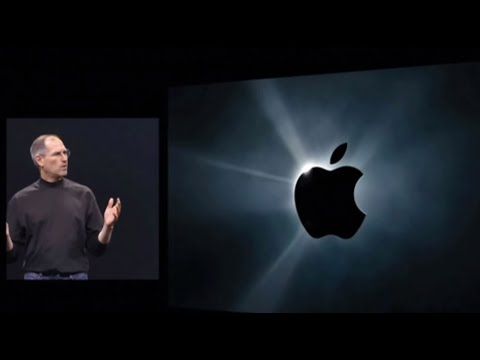
Steve Jobs died in 2011. Apple has sat at or near the top of every brand ranking published since. He is not there, obviously, and a great many of the people now enforcing his standards never met the man, and yet a set of commitments about taste and refusal and what will not be shipped is still being applied daily to products he could not have imagined. Something of him is still choosing.
But look at the hill again, because the hill gives you the honest version of the offer.
Those stamps achieved everything a brand could conceivably hope for. Two thousand years of survival, perfect legibility, a physical monument in the capital city, and an archive so complete that scholars can reconstruct trade routes from it. And nobody feels anything. The names are data now. They persist without being believed in by a single living person, which means they have been preserved and have not survived, and the distinction between those two words is the entire argument of this essay arriving at its destination.
The mark can be kept forever. That is what registries and archives and databases and hills are for. The promise cannot be kept at all, in the storage sense, because it exists nowhere except inside living people who still expect something specific to happen when they reach for the thing. A brand is immortal for exactly as long as somebody alive is still willing to be disappointed by it.
And this is where the technology comes back one final time, because AI is extraordinarily good at the part of this that can be stored. It can reproduce a surface infinitely and keep it forever and regenerate the whole visible identity of a company in an afternoon, and it can do the same for anyone impersonating that company, which is why the checkable mark is becoming strategic again rather than becoming obsolete. What no system can do is manufacture the condition of somebody caring what happens next, because that condition is not a file and cannot be written to disk. We have built a magnificent instrument for producing the kind of survival that the hill already demonstrates is hollow, and it has brought us no closer at all to the other kind.
So we can finally answer the question in the title, and the honest answer is that there is no single reason, because motives do not arrive sorted and any founder who talks for long enough will give you several at once without noticing that they are different.
The first answer is commercial and everybody offers it, which is that a brand reduces friction and lowers the cost of being chosen, and that recognition is cheaper than persuasion, and that a business which has earned the right to charge a premium will outlive one that has not. None of that is cynical, since an organization that cannot sell does not survive long enough to mean anything to anyone, and the people who sneer at this part have usually never had to make payroll.
The second answer is that a brand is an instrument for extending trust further than a person can reach, which is the whole story of the vanishing grocer told in one sentence, and which explains why the discipline appeared exactly when industrial distances made it impossible for a buyer and a maker to look at each other.
The third answer is that people want to build something larger than themselves, meaning an entity that can be in more places than a body can occupy and hold more relationships than a single life has hours for, and which keeps working during the nights and years when its founder is asleep or distracted or simply not very good that week.
The fourth answer is the strangest and I think the most underrated, which is that a brand eventually becomes something very close to another person, with a temperament and a set of things it would never say and a way of behaving when something goes badly wrong. A great many founders are building, whether they would put it this way or not, a version of themselves that is more consistent than they manage to be, one that holds the standard on the days they would have let it slide, and this is why brand work so often feels less like marketing and more like a long and uncomfortable conversation about character.
And underneath all of those sits the one this section has been arguing for, which is that a person who knows they are temporary is arranging for their judgment to keep operating in rooms they will never enter. There are almost certainly further reasons that nobody has articulated properly, and I would not trust any account of this, including mine, that claimed to have found the bottom.
What every one of those answers shares is that each of them requires a stranger to believe you about something they cannot check.
A man in southern Spain pressed his name into a wet clay handle for exactly that reason, and we can read his name today and it moves nobody at all. Somewhere in your city this morning, a person chose one thing over another because of a standard set by somebody who is dead, and did not think about it for even a second, which is the more successful of the two outcomes and the harder one to build.
LILU is a design studio working in brand, identity, and digital design. If you are building something special, we would like to hear from you.
Start a conversation