
There is a sequence that plays out every few weeks now and it is always the same.
A brand publishes a campaign, the image is beautiful and strange in a way that is difficult to place, and within an hour the comments have turned into a forensic investigation. Somebody points at a hand. Somebody points at the way the fabric falls against a railing it does not quite touch. The brand either says nothing, which is read as a confession, or issues a statement that is parsed line by line for what it carefully does not deny.
The reaction is almost uniformly negative, and I want to say clearly before anything else that a lot of it is earned. But I also think the conversation has gotten stuck on a question that matters much less than it appears to, and in the process it is obscuring something genuinely new that is happening at the other end of the industry, among brands nobody is writing about.
I. The backlash, taken seriously
When Levi's announced in 2023 that it would supplement its imagery with AI-generated models, the response was immediate and hostile, and the criticism was not about image quality. It was that a company selling an idea of real people had quietly removed real people, and had presented the removal as a diversity initiative. That framing is what turned a production decision into a story.
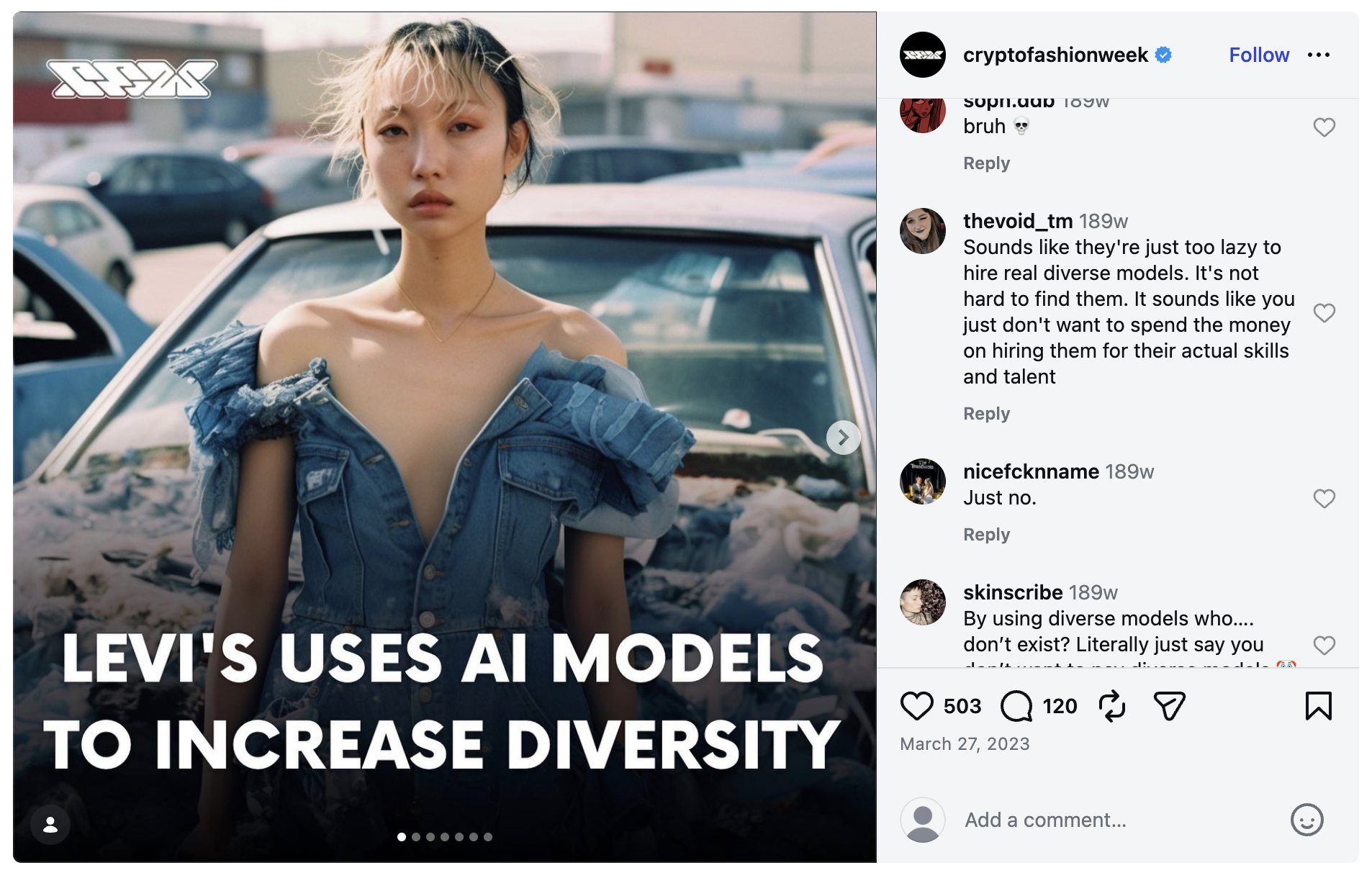
The lesson generalizes, and it is more specific than the industry usually admits. Exposure to backlash scales with how much of your brand's value rests on human authenticity. A technical outerwear company and a heritage denim house can make the identical decision and face completely different consequences, because one is selling a garment and the other is selling a relationship to actual people wearing it.
The second lesson is that the arguments that stick are almost never about whether a machine made the picture. They are about whether anybody was told. Fashion already learned this slowly and expensively about retouching, where the resolution was never to abolish the tool but to disclose, regulate, and let taste mature. The brands handling the current version well are the ones saying so plainly and early rather than being found out.
And there is a third risk that compounds quietly, which is that tools trained on the accumulated center of everything already made will pull your output toward that center, so the cheapest route to competent imagery is also a reliable route to imagery that looks like everybody else's. In a category whose entire proposition is that this particular thing is worth more than a functionally identical thing, drifting toward the average is not a neutral cost.
So the case against is serious. Here is what it misses.
II. For a large brand it is a discount. For a small one it is a door.
Almost every discussion of this is written from the perspective of a company that already has what AI replaces.
A house with a studio, a producer, a crew, a location budget and a standing relationship with 3 photographers is looking at generated imagery as a way to do what it already does for less money. That is a cost line, it is worth something, and it is not very interesting, which is why the coverage keeps circling back to whether it is ethical rather than whether it is useful.
Now consider the other end. A brand with 40 products and a founder who does the packing has never had a location shoot and never will, because the number that matters is not the day rate but everything around it, meaning the permits, the travel, the insurance, the crew, the weather contingency, the season you happen to be in, the fact that the thing you pictured exists 4,000 miles away, and the fact that you need the images in 3 weeks.
For that brand, generated imagery is not replacing a capability. It is granting one that never existed.
This is the part I find genuinely exciting and the part the industry conversation keeps skipping. A founder can now put a coat on a cliff in Iceland in February while standing in a kitchen in Queens. The campaign can be a wolf moving through a winter forest at the edge of the frame, or a figure on the top of a tower above a city at 5 in the morning in a light that only happens twice a year. None of those were decisions a small brand got to make. They were not expensive, they were unavailable, and the difference between expensive and unavailable is the difference between a discount and a door.
What that changes is not the budget. It is the size of the idea a small brand is allowed to have, and for 100 years the ceiling on that has been set by logistics rather than by imagination.
III. Access is not the same as taste
The obvious objection is that if everyone can put a coat on a cliff, cliffs become worthless, and the objection is correct.
The tool grants reach, and reach has never been the scarce thing. What it does not grant is the decision about whether the wolf belongs in the frame at all, whether this brand is the kind of brand that would be on a tower at dawn, and whether the resulting image says anything that the next 400 brands with the same subscription will not also be saying by Thursday.
That judgment is the whole job, and it is the same judgment that has always been the job, which is knowing what to leave out. A generated image costs almost nothing to produce and therefore almost nothing to discard, which means the ratio of things made to things published should go up rather than down, and most of what goes wrong happens because somebody published the fourth thing they generated.
So the honest version of the opportunity has a condition attached. The brands that get something real out of this will be the ones who treat it as a creative medium requiring a point of view, and the ones who treat it as a shortcut will produce exactly what a shortcut produces. Which person is holding it has not stopped mattering.
IV. Meanwhile, the unglamorous half
While the argument about imagery continues, the money in this category is sitting somewhere much less photogenic, and it is worth saying because the 2 things are connected.
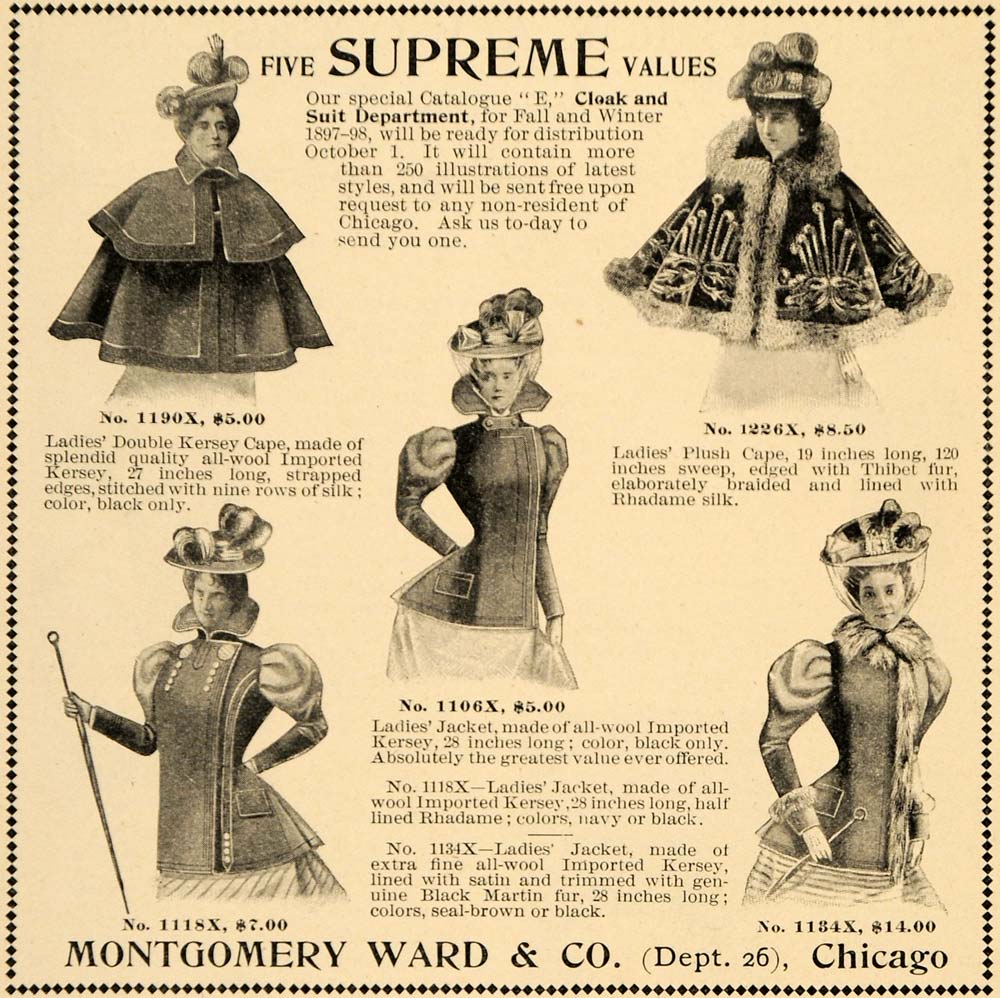
When Montgomery Ward published the first general mail-order catalog in 1872, the thing that made distance selling possible was the return, because satisfaction guaranteed or your money back was the only available substitute for letting a stranger feel the fabric. That bargain still runs fashion e-commerce, except that the return has gone from being the solution to being the largest cost in the category, with online apparel returns commonly reported in the range of 30 to 40% against something closer to 10% in a physical store.
Which gives you a clean test for any use of this technology. Does it narrow the gap between what the customer imagined and what arrived in the box, or widen it?
The uses that narrow it are mostly text and mostly invisible:
Product copy written against the actual spec sheet. Fiber content, weight, drape, stretch, measured garment dimensions, the model's height and the size they are wearing. Most descriptions drift toward adjectives because adjectives are faster than facts, and a correct expectation set at the moment the customer forms one is the cheapest returns intervention available.
On-model imagery across more than 1 body. Customers estimate fit visually and rationalize it with numbers afterward, and a 4-body shoot now costs roughly what a 1-body shoot used to.
Fit guidance from your own returns data. You already know which products come back and why. One specific sentence on the page, saying that something runs small through the shoulder, outperforms any generic recommendation engine.
Search that understands a sentence, because customers search for something to wear to an outdoor wedding in September and your taxonomy was never built to answer that.
Returns triage, meaning reading free-text return reasons at scale and surfacing which 30 products generate a disproportionate share of the cost. Almost nobody does this and it costs nothing.
And one more that follows from something happening outside your site, which is that a growing share of discovery is mediated by assistants reading on a customer's behalf. That reader does not scroll, cannot operate a size selector hidden behind a click, and will not wait for JavaScript to assemble your page. Structured attributes, real measurements and server-rendered product pages are becoming a requirement rather than a refinement, and nobody owns that work internally yet.
V. What I would actually do
1. Fix the copy against the spec sheet, every SKU, this quarter.
2. Read your own returns data and find the 30 worst products.
3. Put a fit sentence on the page wherever you have a known pattern.
4. Decide your disclosure position before you publish anything, not after somebody asks.
5. Then make something nobody else can make, which means starting from an idea rather than from a prompt, and generating 40 of them so you can throw away 39.
Items 1 through 3 protect your margin. Item 5 is the one that might actually change what your brand is, and it only works if you have done the first 4, because an extraordinary image attached to a page that lies about the fit is a return with a delay built in, and it now costs 95% less to make thousands of them.
VI. So which is it
Both, and the split is not between good brands and bad ones.
The criticism is correct that a large house swapping real people for generated ones, quietly, to save money, is doing something small and will deserve what it gets. The criticism has almost nothing to say about a 2-person label that can suddenly put its work in a landscape it could never have afforded to reach, because that brand is not removing anyone. It is arriving somewhere for the first time.
For 150 years the ceiling on what a small brand could show has been set by money and logistics rather than by ideas, and a great deal of the visual hierarchy in fashion is simply a record of who could afford to travel. That particular constraint is lifting, and it is lifting first for the people who have been most excluded by it.
What has not lifted is the part that was always hard, which is having something to say and the discipline to throw away everything that does not say it. The physical world put a ceiling on the small brand and a floor under the big one, and removing the ceiling does not remove the floor, it only means that the advantage now belongs to whoever has better ideas rather than to whoever has a bigger production budget.
I think that is a considerably better arrangement than the one it replaces, and I would rather be having this argument than the one where only 9 companies in the world get to shoot on a cliff.
LILU helps fashion, e-commerce and tech brands create AI imagery that looks natural, from the first idea to the final campaign. If you want images that feel like your brand rather than like a prompt, we are always happy to talk it through.
Start a conversation