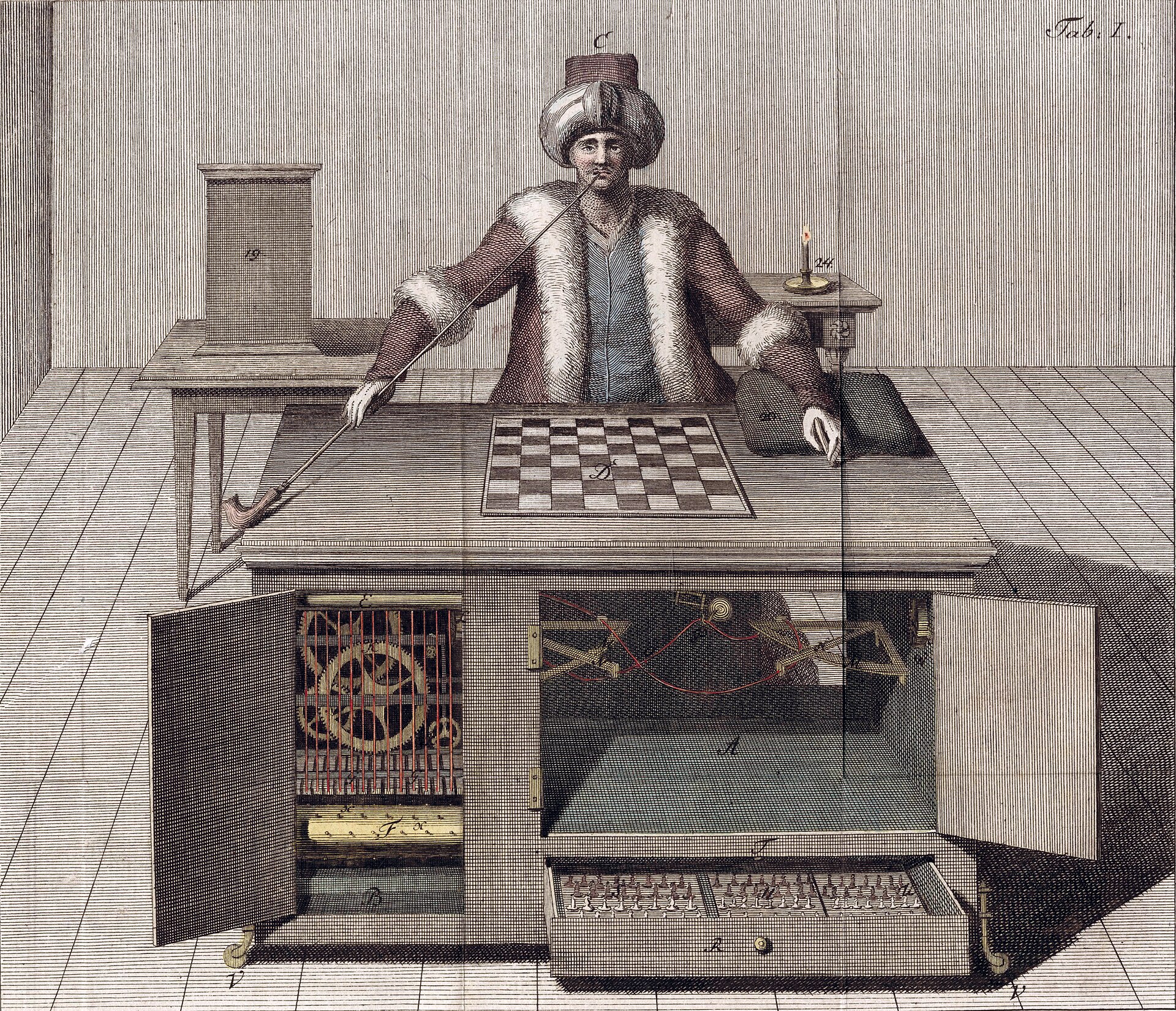
In 1770, a Hungarian engineer named Wolfgang von Kempelen presented a machine to the court of Empress Maria Theresa.
It was a wooden cabinet with a chessboard on top and a carved figure seated behind it, dressed in robes and a turban, and it played chess. It played well. Over the next several decades it toured Europe and America, and it reportedly beat Napoleon and Benjamin Franklin, and audiences argued furiously about what they were looking at.
One camp held that a machine could not possibly think, and that the whole thing was a fraud concealing a person. The other held that mechanism had advanced further than the public understood, and that here at last was proof of what engineering could do. The argument ran for 84 years, through 2 owners and several countries, until the Turk burned in a Philadelphia fire in 1854.
Edgar Allan Poe wrote an essay about it in 1836 and came down firmly on the side of fraud, reasoning that a true machine would play perfectly every time and this one sometimes lost.
He was right that a person was inside. A skilled chess player sat in the cabinet on a sliding seat, moving between compartments as the doors were opened one by one to display the machinery and prove that nobody was there.
But the thing I keep returning to is that both camps were wrong in the same way, and neither of them ever said the true sentence, which was that this was a person and a machine doing something together that neither could have done alone. The human could not have drawn that crowd. The cabinet could not have played a move. What the audience was actually watching was a collaboration, presented as a binary, argued about for 84 years in terms that made the right answer unsayable.
I think we are doing this again.
I. The two camps are not opposites
The public argument about AI is usually described as a spectrum with doom at one end and enthusiasm at the other, and that description is wrong in a way worth being precise about.
At one end are people who believe this technology ends badly, whether through catastrophic misuse, mass unemployment, the collapse of the information commons, or something stranger. At the other are people who believe it ends wonderfully, with disease solved, scarcity reduced and most human drudgery handed off.
Listen to the grammar rather than the conclusion and the 2 positions converge immediately. Both of them have made AI the subject of the sentence and removed people from it. AI will take the jobs. AI will cure the diseases. AI will replace designers. AI will democratize creativity. In each case something arrives from outside the human world and does something to us, and our only remaining role is to brace for it or to welcome it.
That shared premise is what I think is actually false, and it matters far more than which direction the prediction points, because it is the premise that converts every decision into a forecast. If the technology is a weather system then there is nothing to decide and the only intelligent activity is prediction, which is precisely why so much writing about AI reads like meteorology and so little of it reads like somebody describing a choice they made on a Tuesday.
The alternative is not a moderate position between 2 extremes. It is a different claim entirely, which is that this is a thing people are doing, to other people, with tools, in an economy, under incentives that are themselves chosen. That position is not reassuring and it is not a compromise. It is considerably more demanding than either extreme, because it does not let anybody off.
II. My own industry is making the same mistake, from the other direction
Design is currently leaning hard toward the critical end, and the most common phrase I encounter is that art made with AI is not real art.
I understand the feeling underneath it completely and I share a good deal of it. But as an argument it has the same shape as the 1836 argument about the Turk, because it locates authorship in the machinery. It says the tool determines whether the work is real, which is the identical move the evangelists make when they say the tool will make everybody creative. One side says the box cannot produce art and the other says the box produces art for anybody, and both have agreed that the box is the thing doing it.
The history of this discipline does not support either version. Photography was received in 1839 as the end of art, on the explicit grounds that a machine cannot see. The same objection was made about the darkroom, the airbrush, the sampler, the layer mask and the plugin, and in every case the question resolved the same way, which was that some people made extraordinary things with the new tool and most people made forgettable things, in roughly the ratio that held before.

What is genuinely different this time is scale and speed, and I do not want to flatten that. The volume of competent, empty output now available has no precedent, and the objection that it floods every channel is correct. But that is an argument about abundance and attention, not an argument about whether a particular image made by a particular person with a particular intention counts. Those are 2 different complaints, and collapsing them is how the conversation in my industry keeps ending in a mood rather than a position.
III. The strongest version of each extreme, because both deserve one
I would rather state these properly than wave at them, since an essay arguing for a middle position that caricatures its neighbors is not worth reading.
The critics are right about this. These systems were trained on an enormous quantity of work made by people who did not agree, were not paid, and are not credited, and the output competes with them directly. That is a labor and consent objection and it has not been answered, only outrun. They are also right that the apprenticeship is disappearing, since designers have always learned by doing 3 years of unglamorous production work badly and then less badly, and that work is what automates first. And they are right that when something becomes abundant it becomes noise, so a world with far more images is not a world with more seeing in it.
The optimists are right about this. The constraint that limited who could participate in visual culture was never talent, it was access to tools, training and time, and that constraint is genuinely lifting for people it had excluded. Someone with an idea and no budget can now make something that previously required a team, and dismissing that as slop is frequently a way of defending a professional moat while describing it as a defense of standards.
Both of those are true at once. Noticing that is not a compromise between them, it is just accuracy, and the reason it feels like fence-sitting is that our conversation has no comfortable place to put 2 correct things that point in different directions.
IV. What collaboration actually means, and what it does not
I want to be careful here, because collaboration is the word everyone reaches for and it is often doing no work at all.
It is frequently used to mean that a person typed something and a machine returned something and the person felt involved, which is not collaboration, it is ordering. It is also used as a comfortable way to avoid the consent question entirely, since describing a model as a creative partner is a convenient way to not describe where its training data came from.
The version I think is real is narrower and less flattering. These tools are extraordinary at producing options and useless at knowing which one matters, which maps precisely onto the oldest division of labor in creative work. Generation has never been the scarce resource. The scarce resource is the judgment that discards, and what a model does is dramatically lower the cost of the first thing while leaving the cost of the second exactly where it was.
Which means the work shifts rather than disappearing, and it shifts toward the part that was always the hard part. A person who could previously explore 5 directions in a week can explore 50 in an afternoon, and that is only an advantage if they can tell which 49 to throw away. For someone with judgment it is a genuine expansion. For someone without it, it is a machine for producing more of what they would have produced anyway, faster, which is not an improvement in any direction.
V. The thing in the box
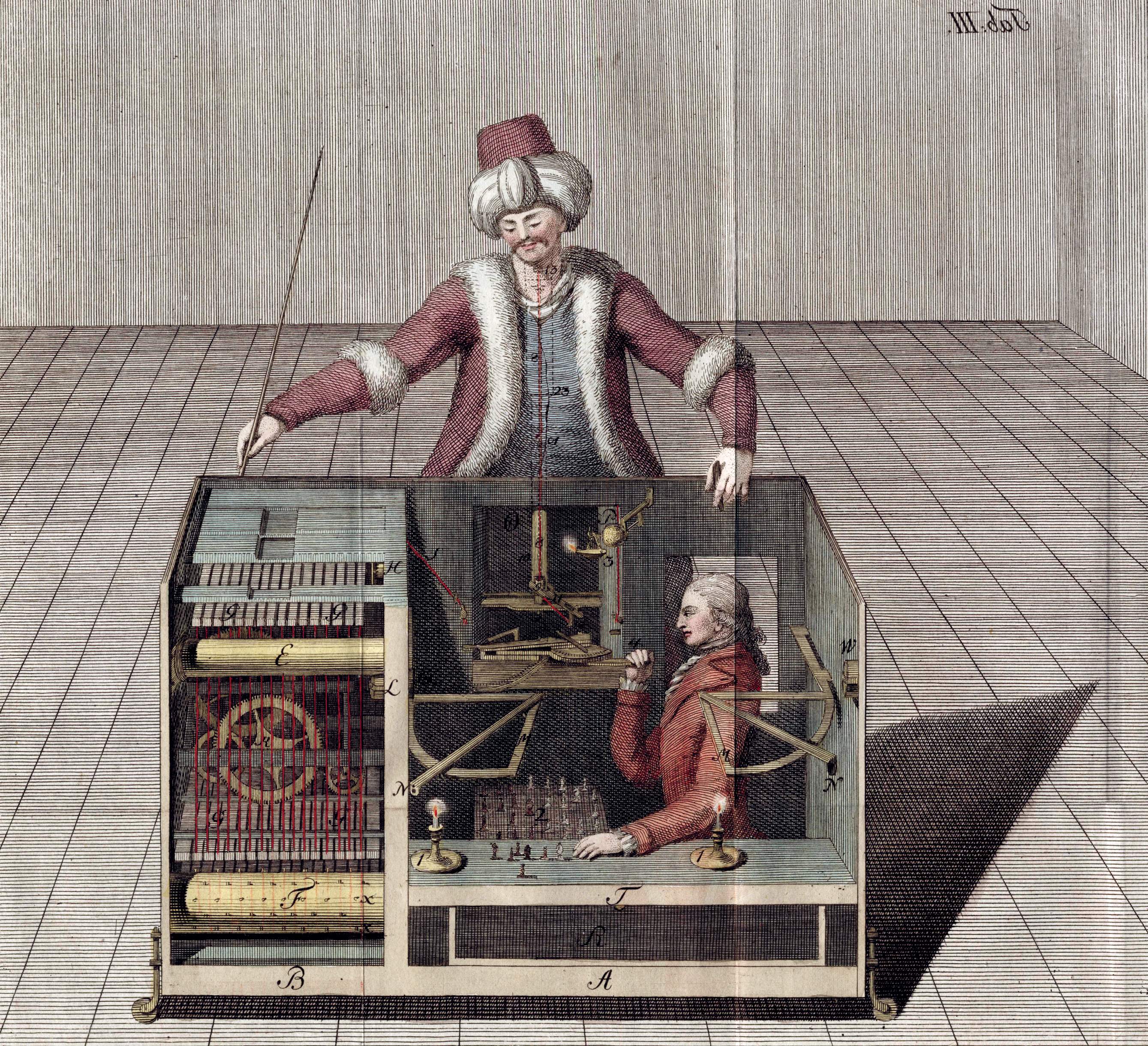
Here is the part I keep coming back to, and it is the reason the Turk is the right object for this argument rather than a decorative one.
What made the machine work was a person. Not metaphorically, not in the sense that an engineer designed it, but literally, in the cabinet, making every decision the audience attributed to gears.
Every one of these systems is the same thing at a scale that makes it hard to see. A model is not an alien intelligence that arrived from outside human culture and began producing images. It is a compression of an enormous quantity of human work, which is to say the paintings, the photographs, the layouts, the sentences and the decisions of a very large number of people, most of whom have no idea they are in there. When a model produces something that moves you, what moved you came from people. It was assembled by a mechanism, and the material is entirely human.
This cuts in 2 directions and I think you have to hold both.
It means the claim that this output is inhuman is close to backwards, since it is made of nothing but human output and the complaint is better understood as being about averaging than about origin. And it means the labor objection is not a side issue to be handled later by lawyers, because if the material is human work then the people who made it are not an externality, they are the input, and an industry built on pretending otherwise is building on a position it will eventually have to defend.
VI. So where does that leave a designer
Not in the middle, which I have come to think is the wrong picture.
Doom and enthusiasm are both ways of being a spectator, and they are restful in the same way, because a prediction asks nothing of you beyond holding it. The alternative is not a milder forecast. It is the considerably less comfortable position of deciding what you will use, what you will refuse, what you will tell your clients, whose work you are willing to build on and what you think is good, and then being answerable for those decisions rather than for the accuracy of your prediction.
I love work made by people and I always will, and I also think these tools bring something real, and I do not experience those as being in tension, because the tools are made of people too. The argument that treats them as opposites is 250 years old and it was wrong the first time, when a crowd stood around a wooden cabinet insisting it had to be either a miracle of engineering or a cheat, while a man sat inside it on a sliding seat, playing chess.
LILU is a branding, design and web development studio in New York City. If you are working through what any of this means for your own brand, we would be glad to think it through with you.
Start a conversation